Lane Departure & Lane Keep
Warns you — or gently steers — if you drift out of your lane without signaling.
If your car has lane-keeping, automatic braking, or other driver-assist features, the camera that runs them sits on your windshield. After a windshield replacement, that camera has to be recalibrated so those safety systems read the road correctly. We handle it — to manufacturer specifications.
ADAS stands for Advanced Driver Assistance Systems — the safety features built into most newer vehicles that help watch the road for you. You probably know them by name: lane-departure and lane-keep assist, automatic emergency braking, forward-collision warning, and adaptive cruise control.
To do their job, these systems rely on a small camera (and sometimes sensors) mounted on your windshield, usually right behind the rear-view mirror. That camera is constantly looking through the glass at the lane lines, traffic, and obstacles ahead.
Most vehicles from roughly 2018 onward with a camera behind the mirror have some form of ADAS.
 The ADAS camera on the windshield
These are the driver-assist systems that depend on a correctly-aimed windshield camera.
Warns you — or gently steers — if you drift out of your lane without signaling.
Applies the brakes for you if it detects a collision is about to happen and you haven't reacted.
Alerts you when you're closing in on the vehicle ahead too quickly.
Keeps a set distance from the car in front and adjusts your speed automatically.
Reads speed-limit and other road signs and shows them on your dash.
Helps keep the car centered in its lane on the highway, working with the camera's view.
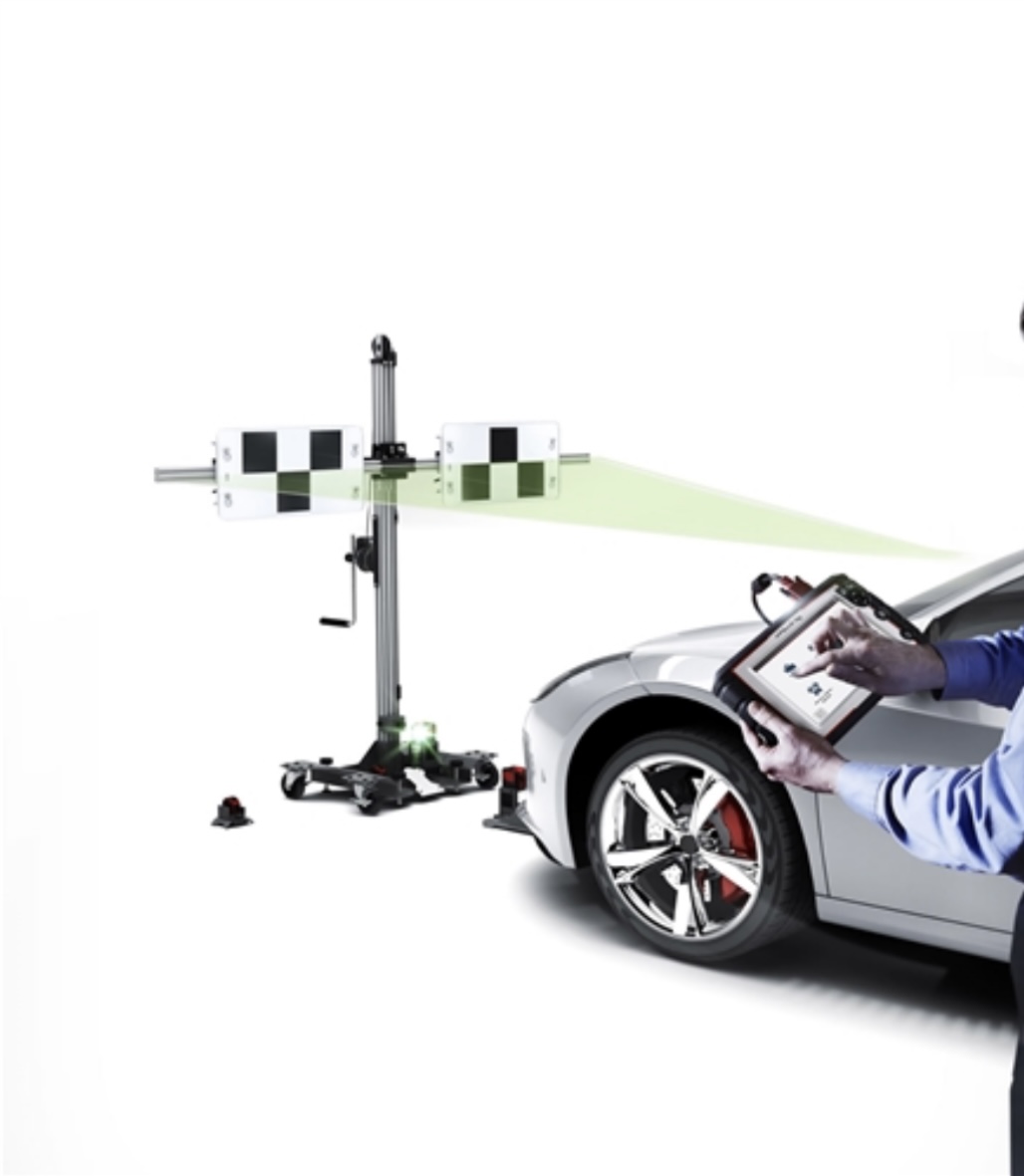 Recalibration realigns the camera to spec
When your windshield is replaced, the camera mounted to it is removed and re-installed on the new glass. Even a shift of a millimeter or a fraction of a degree changes where that camera is aiming.
Because the system is "looking" far down the road, a tiny aiming error at the windshield becomes a big error a hundred feet ahead — so it can read lane lines slightly off, or judge the distance to the car in front incorrectly. Recalibration re-teaches the camera its exact reference point so the safety features work the way the manufacturer intended.
Skipping recalibration can leave automatic braking or lane-keeping reacting late or reading the road wrong — a real safety concern, not just a warning light.
Depending on your vehicle, recalibration is static (with targets), dynamic (a road drive), or both — we follow the manufacturer's procedure for your make and model.
Your new windshield is installed and the camera is mounted back in place.
We connect manufacturer-grade diagnostic equipment to read the camera and systems.
Precise target boards are positioned to spec so the camera re-learns its reference point.
If your vehicle requires it, a controlled road drive lets the system re-learn real lanes and traffic.
We confirm there are no fault codes and the systems are reading the road correctly.
If any of these apply, your vehicle most likely needs an ADAS recalibration — and we'll confirm it for you.
If your vehicle has a camera behind the rear-view mirror and driver-assist features like lane-keep, automatic braking, or adaptive cruise, then yes — after windshield work it needs recalibration. We check your specific make, model, and year and tell you for certain before any charge.
For ADAS-equipped vehicles, manufacturers require the camera to be recalibrated any time the windshield is replaced. The camera is mounted to the glass, so replacing the glass moves the camera and it must be re-aimed to spec.
Most recalibrations add roughly 30 to 90 minutes after the windshield is installed and the adhesive has set, depending on whether your vehicle needs a static calibration, a dynamic (road-drive) calibration, or both. We give you an exact estimate for your vehicle.
Your driver-assist features may behave unpredictably — braking late, reading lanes incorrectly, or throwing dashboard warnings. Because these are safety systems, it's not something to leave uncalibrated. Recalibrating restores them to how the manufacturer designed them to work.
Yes. We perform ADAS recalibration as part of your windshield service using proper diagnostic equipment and manufacturer procedures — so you don't have to make a separate trip to the dealer. We'll explain what your vehicle requires when you book.
Get a free quote and we'll confirm whether your vehicle needs recalibration — then handle the glass and the recalibration together, to manufacturer spec.